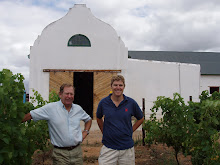
We are half way through spring in the Robertson Valley. This is actually the busiest time of the year in the vine’s cycle. Many people believe that harvest is busier, but I find that harvest is fairly routine. During springtime you have to do the following:
· Suckering – this is the removal of excess shoots (very time consuming)
· Lifting trellis wires – to stop shoots being blown off during strong spring winds, which we experienced last night.
· Trim the shoots when they reach a certain height, otherwise they will topple over and become unruly.
· Monitor for disease – Powdery mildew is the most common disease followed by Downy mildew.
· Spray if disease is identified.
So far the jobs have gone well, but we do have a small outbreak of downy mildew. This is fungal disease, which you first identify on the leaf as an “oil spot”. The disease can attack the bunch as well, especially during flowering. It causes the young bunch to wither away and die, which is obviously a financial problem. Ideal conditions for the development of the disease is known as the 10, 10, 24 combination. This stands for:
· 10 millimeters of rain
· A temperature of greater that 10 degrees Celsius
· The leaf must be wet for 24 hours or longer.
We have had two such events in the last two weeks. We have already seen the first “oil spots” on the leaves, so we have to dust-off the spray carts and get to work. We do not like spraying, and in a normal year we do not spray at all (thanks to Robertson’s healthy climate), but in this situation it is not worth the risk.
We generally use contact sprays, as the plant does not take them up. We are using copper, as this kills the mildew, and as been used for centuries on vines. Organic growers tend to use copper for downy mildew, but in different formats to us.
This is one of the aspects of grape growing where you have to weigh up the advantages and disadvantages of certain actions. In this case we believe that the advantages outweigh the disadvantages.
Monday, October 26, 2009

Saturday, October 10, 2009
US and Chardonnay
I have just spend close to 3 weeks traveling around North America – more specifically LA, Vancouver, NY, New Jersey and Memphis. Yes I did go to Graceland, and Beale street, and ate great BBQ!
Selling wine in the US is great becomes you get direct honest feedback. If people feel that they can sell your wine and make a couple of bucks, they will buy. One thing that struck me on this trip was how amazed people were with our Chardonnay.
I was often told – I don’t drink Chard, its too oaky, or I have too many Chards on my shelf, so why would I carry a South African one. Once they tried the Excelsior, they were invariably impressed and bought the wine.
We produce a very lightly oaked style (many asked if there is any oak in the wine) that has good acidity. More importantly, there is no malo-lactic fermentation done on the wine, which gives chardonnay those typically buttery flavours. Our flavour profile is lemony, and fresh. The wine definitely tastes like Chard, but we want the consumer to reach for a second (and even third) glass.
I believe the wine industry missed a trick by producing oceans full of those oaky, oily chardonnays, as the consumers have been totally turned off by them.
Selling wine in the US is great becomes you get direct honest feedback. If people feel that they can sell your wine and make a couple of bucks, they will buy. One thing that struck me on this trip was how amazed people were with our Chardonnay.
I was often told – I don’t drink Chard, its too oaky, or I have too many Chards on my shelf, so why would I carry a South African one. Once they tried the Excelsior, they were invariably impressed and bought the wine.
We produce a very lightly oaked style (many asked if there is any oak in the wine) that has good acidity. More importantly, there is no malo-lactic fermentation done on the wine, which gives chardonnay those typically buttery flavours. Our flavour profile is lemony, and fresh. The wine definitely tastes like Chard, but we want the consumer to reach for a second (and even third) glass.
I believe the wine industry missed a trick by producing oceans full of those oaky, oily chardonnays, as the consumers have been totally turned off by them.
Tuesday, September 29, 2009
Snails
Excelsior prides itself on looking for environmentally friendly practices, and this extends to pest control. Far and away the most costly pest on Excelsior is the humble snail. For the past decade we have moved towards using less and less herbicides, and avoid sloughing as this has a detrimental effect on soil structure. This is known as minimal tillage. The benefits are a more “living” soil, as there is plenty of food for earthworms (which burrow down and open up the soil, allowing oxygen and root penetration), as well as micro – organisms, which help the plant access nutrients.
The major drawback is that this provides the perfect environment for snails to breed. There is plenty of shelter, and food all year round. And can they breed! A snail is hermaphroditic (both sexes can lay eggs) and each snail lays approximately 50 eggs each.
Now the harmful snail is the non-edible small white snail called Theba Pisana. It absolutely thrives in the arid lime soils of the Robertson area. It uses the lime to produce a very hard shell, which makes it fairly unpalatable for the traditional snail predator – the duck. Ducks work well for controlling some species of snails and slugs, but not the white snail.
We use a poisonous bait (mixture of Bran and poison) that dehydrates the snail, and is quite effective. The problem is that animals, especially dogs, are also fond of it, and it can kill them. Using poisons is also not good for the environment, and it is damn expensive.
I have been searching for a softer cure for snails, and I believe that I have found one. Iron is poisonous to snails. It is the ultimate diet pill for them, as it completely suppresses their appetite, until they starve to death. I use a common agricultural fertilizer called iron sulphate, and mix it into the bran in place of the normal poison. This year I have done about a third of the farm with this mixture and will monitor the outcome. But so far it looks extremely promising, and the added bonus is that it is very cheap.
The major drawback is that this provides the perfect environment for snails to breed. There is plenty of shelter, and food all year round. And can they breed! A snail is hermaphroditic (both sexes can lay eggs) and each snail lays approximately 50 eggs each.
Now the harmful snail is the non-edible small white snail called Theba Pisana. It absolutely thrives in the arid lime soils of the Robertson area. It uses the lime to produce a very hard shell, which makes it fairly unpalatable for the traditional snail predator – the duck. Ducks work well for controlling some species of snails and slugs, but not the white snail.
We use a poisonous bait (mixture of Bran and poison) that dehydrates the snail, and is quite effective. The problem is that animals, especially dogs, are also fond of it, and it can kill them. Using poisons is also not good for the environment, and it is damn expensive.
I have been searching for a softer cure for snails, and I believe that I have found one. Iron is poisonous to snails. It is the ultimate diet pill for them, as it completely suppresses their appetite, until they starve to death. I use a common agricultural fertilizer called iron sulphate, and mix it into the bran in place of the normal poison. This year I have done about a third of the farm with this mixture and will monitor the outcome. But so far it looks extremely promising, and the added bonus is that it is very cheap.
Friday, September 18, 2009
competions
Excelsior has just won a Gold and Double Gold medal in a very important wine competition. We are very proud of this achievement, and it should help sales along nicely. But winning medals is not what producing wine is all about.
Wines in a competition are tasted blind, which means that a judge has no idea of the identity of the wine. This is the only fair way of judging, as our knowledge of a product will influence our judgement of it. If you know you are drinking the most expensive wine in the world, you are going to try and enjoy it no matter what!
If your wine does not win in a competition, it does not mean that the wine is not good. All it means is that it did not stand out in line-up of maybe 90 odd wines.
We place far greater emphasis on things like sales rates - if the wine is selling well, customers must be enjoying it. Another trick I have learned in the past few years is to do a google search of my particular wine, eg Excelsior Cabernet 2007. I get to see what customers are saying about the wine online. This way I am able to track and compare vintages and styles, and what customers feel about them. And comments are spot on. There have been times when I have not been totally sure of a wine, and I will notice more negative comments and descriptions. Obviously you are never going to please all, but if most enjoy the wine, then you are on the right track.
So the best judge is probably the person who is drinking the wine, as he or she is the one who has to enjoy it or not.
Wines in a competition are tasted blind, which means that a judge has no idea of the identity of the wine. This is the only fair way of judging, as our knowledge of a product will influence our judgement of it. If you know you are drinking the most expensive wine in the world, you are going to try and enjoy it no matter what!
If your wine does not win in a competition, it does not mean that the wine is not good. All it means is that it did not stand out in line-up of maybe 90 odd wines.
We place far greater emphasis on things like sales rates - if the wine is selling well, customers must be enjoying it. Another trick I have learned in the past few years is to do a google search of my particular wine, eg Excelsior Cabernet 2007. I get to see what customers are saying about the wine online. This way I am able to track and compare vintages and styles, and what customers feel about them. And comments are spot on. There have been times when I have not been totally sure of a wine, and I will notice more negative comments and descriptions. Obviously you are never going to please all, but if most enjoy the wine, then you are on the right track.
So the best judge is probably the person who is drinking the wine, as he or she is the one who has to enjoy it or not.
Tuesday, September 1, 2009
the beginining

I am the fifth generation to be privileged to work and own Excelsior.
Times have changed since Koos de Wet (my Great, Great Grandfather) bought the farm in 1859. The farm was just native bush, with no buildings. Those days he farmed with ostriches, cattle, fruits such as peaches and apricots, as well as producing sweet fortified wines. South Africa in those days had very little infrastructure, so any fruit that was produced had to be dried, and any wine that was produced had to be fortified with spirits to preserve it. Cattle could be driven to market. For the rest agriculture was subsistence based.
My Great Grandfather, Kowie, introduced Hackney horses to Excelsior, and produced sweet fortified wines. The invention of the motorcar ended the Hackney horse industry, so he turned his attention to racehorses. During his time on the farm the ostrich industry also collapsed dramatically.
My Grandfather, Oscar, bred thoroughbred race horses, as well as Dairy cattle. He also produced sweet fortified wines. As you can see we always produced wine of some sorts.
The modern era of agriculture started with my father, Freddie, who introduced dynamic ideas like drip irrigation, and build a modern winery in 1981. This enabled modern dry wines to be produced. In the beginning these wines were mainly white, but in the early 1990’s reds were introduced as they suite the terroir of Excelsior. Due to changes in South Africa’s politics, we were able to export, so this was the next major change in way things were done at Excelsior.
Today Excelsior sells wine in over 20 countries, and we travel the world to sell our wines. So things have changed considerably in the past 150 years – unimagined changes. I am using the technology available to bring you insights into what it is like to be a wine farmer in South Africa 150 years after the business started.
Subscribe to:
Posts (Atom)